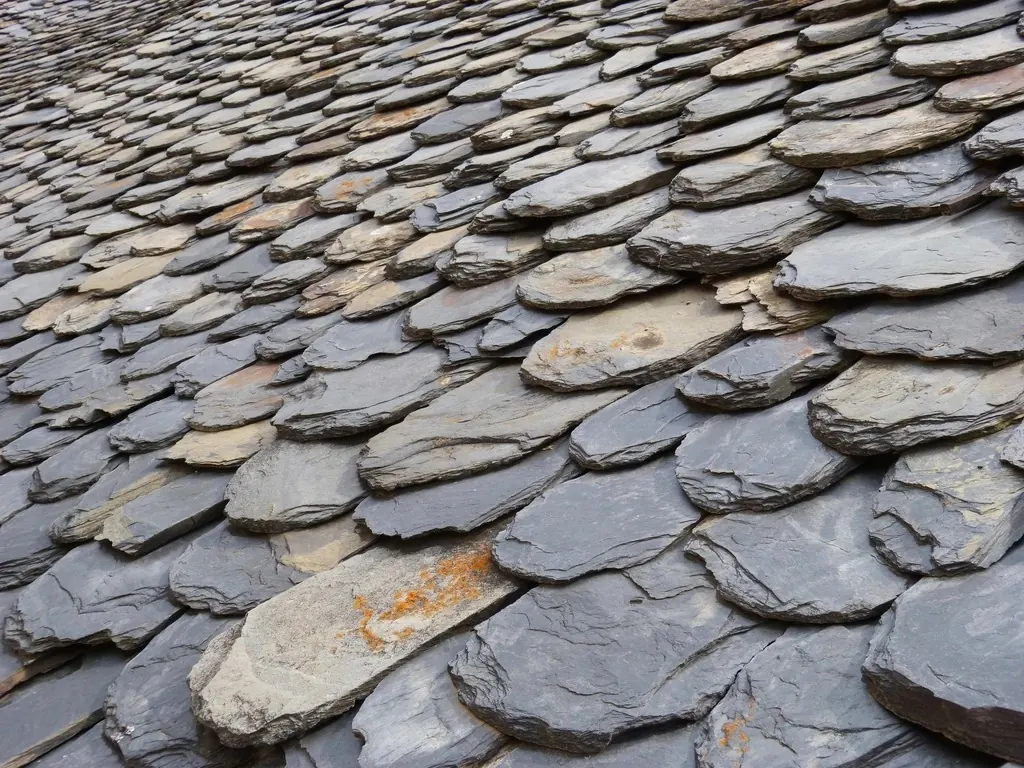
Ohio’s older roofs are a different claim
Ohio has a deep stock of pre-1940 houses: brick doubles in Columbus’s older neighborhoods, Queen Annes in Zanesville and Marietta, Tudor revivals in Shaker Heights and Upper Arlington, farmhouses across the northwest. Many still wear slate, clay tile or early asphalt roofs that newer subdivisions never had. When a spring or summer hailstorm moves through, these roofs raise questions that a 15-year-old architectural shingle roof does not. Ohio slate roof hail damage in particular tends to generate disputes over three things: whether the damage is real, whether the roof can be repaired, and whether the repair will match.
Is the slate actually damaged?
Slate is hard, and it does not dent the way metal does. Hail damage typically shows as fractures, broken corners or crescent-shaped chips, sometimes with a bruise-like crack visible only from the underside. Older slate that is already soft or delaminating may break more easily, which leads to arguments over whether the hail caused the break or simply finished off material near the end of its life.
Careful inspection helps. Useful evidence includes:
- Fresh, clean fracture surfaces rather than weathered or stained edges.
- Collateral damage on gutters, downspouts, vents, flashing and window wraps.
- Patterns consistent with the storm’s direction across slopes.
- Counts of broken slates per slope, documented with photos and a roof diagram.
Test squares are a familiar tool on shingle roofs; on slate, a full count of broken pieces per slope is often more persuasive.
Timing matters as well. Ohio hail season runs mainly from spring through summer, and an older roof may have absorbed more than one storm. Insurers sometimes argue that damage came from an earlier event or from age. Dated photos from before the storm — real estate listings, home inspection reports, even street-level images — can help establish what the roof looked like beforehand.
Repair or replace?
A slate roof can often be repaired one piece at a time — if replacement slate of the same type, size, color and thickness can be found, and if a crew can walk the roof without breaking more than they fix. That is where the age of the house begins to drive the estimate. Questions that commonly come up:
- Availability. Is the original slate still quarried, or will salvaged pieces be needed?
- Breakage during repair. Brittle slate can crack under foot traffic, adding damage the original estimate did not include.
- Fasteners and underlayment. Old nails and felt may fail when slates are pulled, turning a spot repair into a section replacement.
- Labor. Slate work is specialized and priced accordingly; general shingle pricing does not fit.
The same logic applies to discontinued asphalt shingles. If the shingle line is no longer made and nothing on the market comes close, a few replaced tabs can leave a patchwork that is obvious from the street.
Copper or terne flashing, built-in gutters and decorative ridge details on older houses add their own costs. These components often cannot be reused once disturbed, and a repair estimate that leaves them out understates the job. Ask the slate contractor to price them separately so the panel can see them.
Matching and the age of the house
Matching disputes ask whether the insurer must pay to replace undamaged material so the repaired area blends with the rest. Policy language varies, and many Ohio policies say little about it directly. Insurers often point to “like kind and quality.” Policyholders often point to the practical result: a roof or elevation that no longer looks uniform. The Ohio Department of Insurance’s claim-handling rule, Ohio Administrative Code 3901-1-54, addresses replacement of items when an exact match cannot be found, and its reasonableness standard is frequently cited in these discussions. How it applies to a given claim depends on the facts and the policy.
Age also affects depreciation. A 90-year-old slate roof may have decades of life left, while an asphalt overlay installed over it in the 1980s may not. Estimates that apply a single depreciation rate to the whole roof can be badly off.
Keep in mind that every Ohio slate roof hail damage claim is fact-specific. Two neighboring houses on the same street can have different slate, different prior repairs and different policy forms, and reach very different results.
Bringing it to appraisal
When the insurer agrees there is covered hail damage but disagrees on scope or price, appraisal can settle the question with someone who understands older roofing. Bring the panel your best evidence: slope-by-slope counts, measurements and pitch (our roof area and pitch calculator can help), quotes from a slate specialist, and documentation of any discontinued material. Our hail and roof appraisal service works with slate, tile and older asphalt roofs across Ohio.